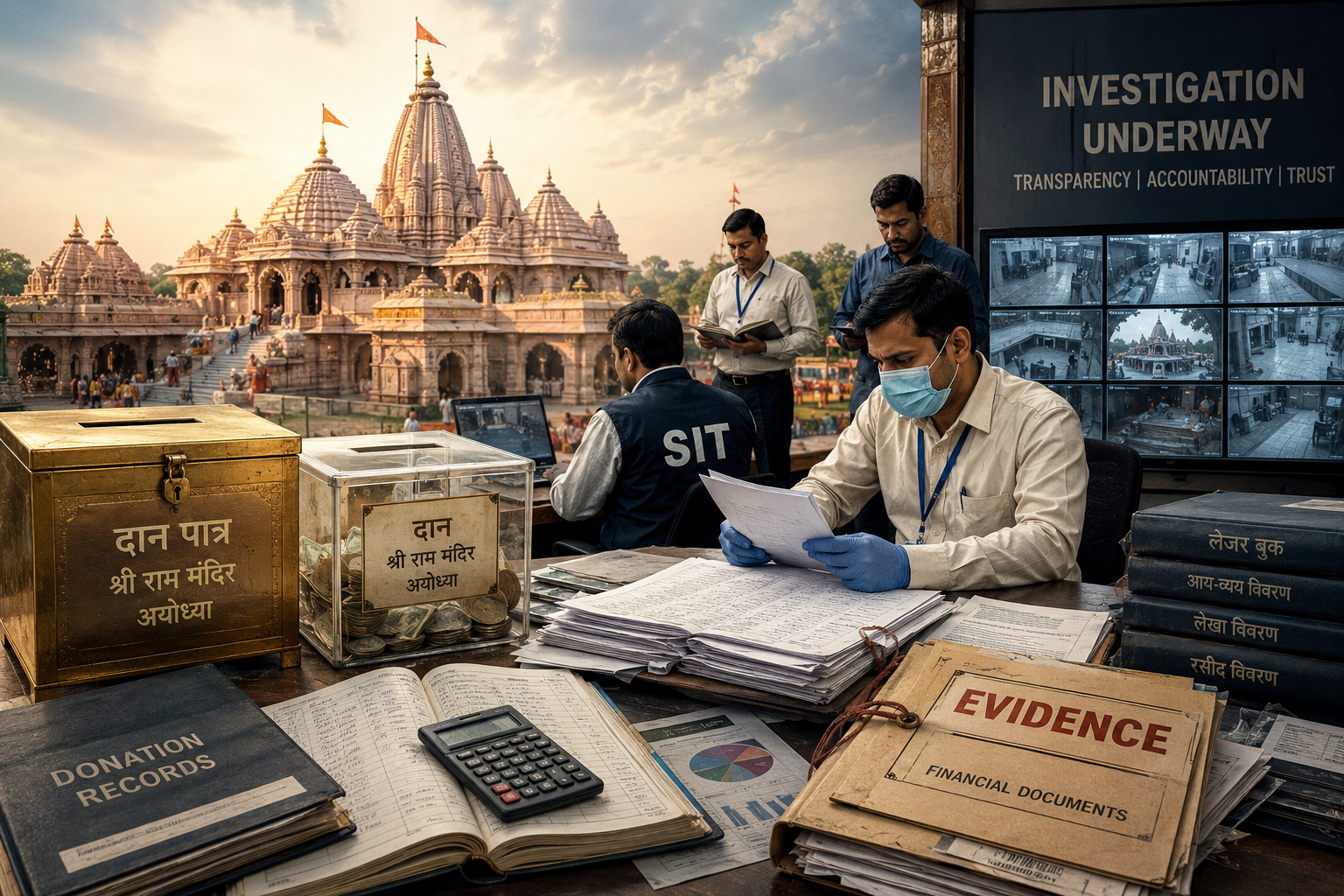
The offering had been made in good faith. A five-hundred-rupee note, pressed into a donation box by a pilgrim who had waited hours in the Ayodhya — one of the hundreds of thousands who descended on the Ram temple each day during the fevered weeks of the Maha Kumbh in early 2025.
By the time investigators installed hidden cameras inside the counting room months later, that note’s fate had already been decided: it would never reach any sanctioned account.
Instead, CCTV footage would later show a staffer deliberately stepping in front of a fixed camera while a colleague quietly slipped loose notes into the folds of his clothing.
It is a story about faith betrayed but it is equally a story about systemic failure, political convenience, and the peculiar vulnerabilities created when a sacred site becomes a billion-rupee enterprise.
The Ram temple in Ayodhya, consecrated by Prime Minister Narendra Modi on January 22, 2024, was always going to be more than a place of worship. For its architects religious, political, and administrative it was also meant to be a monument to institutional credibility. What the events of June 2026 have exposed is how badly that credibility has frayed.
“Cash was first stashed in temple bathrooms before being smuggled out and divided. The racket, investigators believe, had been running since the day the temple opened.”
THE FLOOD OF DEVOTION — AND DONATIONS
Few religious institutions in modern India have generated wealth at the pace of the Shri Ram Janmabhoomi Teerth Kshetra Trust since its most celebrated landmark opened to the public.
The temple’s grand consecration ceremony drew hundreds of dignitaries and was broadcast live across every major Indian television channel, making it among the most-watched religious events in the country’s history. What followed was a sustained and extraordinary pilgrimage.
During the Maha Kumbh period of January and February 2025, the footfall was staggering. According to investigators, close to ten lakh devotees one million people visited the temple each day. Donation boxes overflowed with currency, and the altars received gold ornaments, silver vessels, diamond rings, bracelets, anklets, and other valuables.
The trust’s own financial records show that it received ₹82.78 crore in donations between April 2025 and February 2026 alone. For the full fiscal year 2024-25, the trust declared an income of ₹3.27 billion approximately $39 million.
Numbers of that scale demand rigorous oversight. What investigators from the Special Investigation Team (SIT) would eventually uncover was that the oversight in place was, at best, inadequate — and, at worst, deliberately circumvented.
THE SUSPICION THAT STARTED IT ALL
The trail toward accountability began not with a journalist, not with an opposition politician, but inside the trust itself and even then, only after something anomalous appeared in a routine financial reconciliation.
In the last week of May 2026, trust officials were reviewing the money being deposited into bank accounts relative to the daily emptying of donation boxes.
A single figure stood out: approximately ₹6 to ₹7 lakh was typically deposited in one go from a particular box, but for several consecutive weeks, the bundles of five-hundred-rupee notes showed a persistent shortage. It was not a dramatic discrepancy. But it was consistent, and consistency suggested pattern rather than error.
The trust responded not by contacting police, but by installing covert cameras inside the note-counting room. Within a single week of footage review, the mechanism of the theft was laid bare. Counting staff were working in coordinated pairs.
One employee would position himself directly in front of a fixed CCTV camera obscuring its sightline while the other extracted notes from currency bundles and concealed them in his clothing.
A separate method involved padding bundles with extra notes during counting, then quietly removing those notes during the transfer to the bank, ensuring the final tally on the voucher matched the amount delivered, with the surplus simply vanishing in transit.
The stolen cash, according to sources familiar with the investigation, was first hidden in the temple’s own bathroom facilities before being removed from the premises entirely and distributed among those involved.
The investigation identified at least seventy theft incidents recorded in CCTV footage between April 27 and June 5, 2026 but the timeline of the alleged racket, sources believe, extends back to the day the temple opened in early 2024.
“No employee leaving the counting room was frisked. CCTV footage was deleted after 45 days instead of the mandated 180. The keys to several donation boxes were held by the personal driver of the Trust’s own General Secretary.”
A SYSTEM BUILT TO FAIL
When the SIT, constituted by the Uttar Pradesh government on June 14, 2026, at the trust’s own request, began its work, it was not only looking for thieves. It was also mapping what had allowed the theft to continue, apparently unchecked, for so long.
Its preliminary findings, submitted to the state government on June 23, described a cascade of procedural violations. Standard Operating Procedures that the trust and State Bank of India representatives had themselves codified in 2025 triggered, ironically, by the same early suspicions that later prompted the hidden cameras had been ignored wholesale.
The SOPs required counting staff to wear clothing without pockets. They required a security guard deployed by a contracted agency, Sainik Security Services, to be present at all times during the counting process. They required regular frisking of all personnel entering and leaving counting rooms. They required CCTV footage to be retained for 180 days. None of these requirements was observed.
The footage was being deleted after just 45 days. Staff arrived in regular clothing. No security agency guard appears in the footage of the counting process. And the frisking the simplest and most direct deterrent against physical theft was never conducted.
Perhaps the most striking single detail concerns one Ramashankar Yadav, known by the alias Tinnu Yadav. Tinnu was the former personal driver of Champat Rai, the trust’s General Secretary. At the time of the alleged embezzlement, Tinnu held keys to several of the temple’s donation boxes.
The investigation also revealed that Tinnu had arranged for his own relative, Manish Kumar Yadav, to be placed in the cash-counting unit. One accused, Anukalp Mishra, was responsible for producing donation vouchers, and appears to have manipulated that process in coordination with his brother-in-law, Lavkush Mishra, who worked in the counting team.
The SIT also flagged a troubling anomaly in staffing appointments. The donation counting in-charge, Subhash Srivastava, was reportedly appointed on the recommendation of one of the trust’s three most senior figures a detail that raised questions about whether those in formal leadership positions were alert to what was unfolding beneath them, or deliberately incurious about it.
THE ARRESTS, THE RECOVERIES, AND WHAT THEY SUGGEST
On June 25, 2026, an FIR was registered under the Bharatiya Nyaya Sanhita, carrying charges of criminal breach of trust, theft, cheating, criminal conspiracy, and provisions of the Prevention of Corruption Act the last significant because State Bank of India employees were among those implicated.
Eight individuals were arrested: Avinash Shukla, Anukalp Mishra, Lavkush Mishra, Manish Kumar Yadav, Karunesh Pandey, Ramashankar Mishra, Subhash Srivastava, and Tinnu Yadav. A court remanded all eight to judicial custody.
From six of the eight accused, police recovered approximately ₹80 lakh in cash, along with some foreign currency.
One of the accused, Avinash Pandey, was found to have deposited a portion of the stolen donations directly into his own bank account a remarkable recklessness that investigators attributed to the apparent assumption that no one would notice.
The stolen items were not limited to currency. Among the valuables taken from donation boxes were gold earrings, nose rings, bracelets described as ‘Bal Roop Ram Lal’ ornaments, anklets, and jhumkis.
The act of stealing devotional jewelry, items offered by pilgrims in an act of personal sacrifice and spiritual devotion, has struck many observers as a particular desecration one that the bare legal language of the FIR does not quite capture.
THE RESIGNATIONS THAT CHANGED THE POLITICAL CALCULUS
For several weeks after the initial reports of irregularities appeared in early June 2026, the trust and its political allies attempted to manage the controversy quietly.
The SIT was presented as a swift and sufficient response. The arrests, when they came, were framed as evidence that the system was working. The problem, it was suggested, lay with a handful of rogue junior employees not with the institution’s governance.
That framing collapsed on June 26, when Champat Rai, the General Secretary of the Shri Ram Janmabhoomi Teerth Kshetra Trust and a Vice-President of the Vishwa Hindu Parishad, resigned his position. Trust member Anil Mishra also stepped down. Both cited ‘moral responsibility’ in connection with the controversy. The FIR, notably, named neither of them as accused.
The resignations were politically necessary but legally inconclusive. Champat Rai had been the administrative face of the trust since its earliest years, presiding over the project that the BJP treated as among its most consequential deliveries to its voter base.
His exit shifted the political geography of the controversy — but also, as several commentators noted, raised the question of what moral responsibility means when it is taken without legal accountability following it.
A former bureaucrat who had been associated with the trust’s construction oversight initially distanced himself from the financial handling of donations, a move that drew criticism across the political spectrum.
His suggestion that he had no involvement in the trust’s financial affairs was widely read as an attempt to insulate himself from the fallout and served, if anything, to deepen the impression that those at the top of the institution had exercised either negligent or willfully indifferent oversight.
“The BJP had already suffered a setback in Ayodhya during the 2024 Lok Sabha elections. A prolonged controversy surrounding the Trust could further complicate the party’s political prospects in Uttar Pradesh ahead of 2027.”
THE POLITICAL STORM AND WHAT IT REVEALS
The Ram temple was never an apolitical project. From the Supreme Court’s 2019 verdict clearing the way for its construction to its consecration ceremony attended by the Prime Minister and broadcast nationwide, it has been inseparable from the identity and electoral strategy of the Bharatiya Janata Party. That inseparability is now the scandal’s defining political dimension.
The opposition has moved with unusual urgency. Congress leader Priyanka Gandhi Vadra called the alleged theft ‘tragic’ and ‘shameful,’ and questioned publicly whether junior-level employees could independently have disabled CCTV systems and stolen crores of rupees pointing to the implication of a broader conspiracy, or at minimum a broader negligence, at higher levels.
Congress demanded dissolution of the existing trust, an investigation monitored by a sitting Supreme Court judge, and that the administration of the temple be transferred to religious leaders including Shankaracharyas.
Aam Aadmi Party national convenor Arvind Kejriwal, visiting the temple in person, alleged that as much as ₹200 crore in cash may have been stolen, along with gold jewellery, silver including a reported 200-kilogram silver donation that he alleged was also taken and diamonds.
Investigators have not confirmed that estimate; the ₹200 crore figure remains a political allegation, not a verified finding. But it has proved resonant precisely because the scale of the verified donations makes a large theft arithmetically plausible.
Samajwadi Party president Akhilesh Yadav questioned whether the SIT could be trusted to conduct an impartial investigation given its formation by a state government led by a party with direct political stakes in the outcome of that investigation. Congress formally alleged that investigators were examining only a narrow window — April 2025 to February 2026 — leaving questions about losses across the full two-plus years of the temple’s operation entirely open.
The ruling party’s response was sharper in tone than in substance. Chief Minister Yogi Adityanath warned the opposition not to ‘cast an evil eye’ on the temple and challenged critics to submit evidence if they had it. The framing was familiar: the temple as a symbol too sacred for political attack. But the arrests had already confirmed that some form of financial misconduct had taken place. The question of scope, and of accountability up the chain, remained unanswered.
THE WHISTLEBLOWER AND THE QUESTIONS OF SCOPE
Before the trust installed its hidden cameras, before the SIT was formed, before a single arrest was made, one person had been raising concerns through official channels and reportedly being removed from his post for doing so.
Mahipal Singh, a former supervisor of the trust’s accounts team, is widely credited as the original whistleblower in this matter. According to sources, he raised internal concerns about the handling of cash offerings and precious metals and was subsequently relieved of his responsibilities.
His account has not been independently verified in full, and his removal may have had other administrative explanations — but his trajectory follows a pattern familiar from institutional fraud cases: the person who sees it early is treated as the problem.
A separate complaint was filed by Santosh Dubey, a former kar sevak who participated in the Ram Janmabhoomi movement in the 1980s, at the Ram Janmabhoomi police station in Ayodhya. His complaint preceded the SIT’s formation and was among the early signals that the controversy could not be contained.
In an interview, Dubey expressed frustration with the pace of accountability: ‘Why is Bulldozer Baba not taking any action?’ — addressing Chief Minister Adityanath by a well-known public nickname. ‘Those who have looted money belonging to Ram, what action has been taken?’
It is a question many devotees are asking — and it will not be answered by eight arrests alone.
THE LEGAL LANDSCAPE — AND WHAT A FULL AUDIT MIGHT REVEAL
The controversy has generated a wave of legal activity alongside the criminal investigation. A Public Interest Litigation filed before the Supreme Court by Advocate Anoop Prakash Awasthi sought CBI involvement and an independent probe.
A separate PIL by Advocate Moti Lal sought a judicial commission under a High Court or Supreme Court judge and the freezing of trust bank accounts. A third PIL sought preservation of financial records and digital evidence alongside a CAG audit covering the trust’s accounts from inception.
The Supreme Court, as of late June 2026, declined to hear any of these on an urgent basis, effectively leaving the matter with the SIT and the Uttar Pradesh criminal justice system for now.
A full Comptroller and Auditor General audit would be the most consequential potential development: it would cover not merely the narrow window the current investigation addresses, but the full financial history of an institution that has, over two years, managed billions of rupees in public donations with governance structures that the SIT has already described as inadequate.
The FIR names unidentified additional persons alongside the eight already arrested — an indication that investigators themselves expect the network to be wider. The SIT’s preliminary report recommended ‘deeper scrutiny of staff appointments, authorisation procedures and supervisory controls,’ language that suggests its authors believe the story does not end with those currently in custody.
THE HARDER QUESTION
Behind the legal filings and the political point-scoring lies a harder, quieter question: what does it mean for the millions of Indians who donated to the Ram temple — not as a political act, not as a declaration of affiliation, but as an expression of something private and deeply felt?
For a pilgrim who saved for months to make the journey to Ayodhya, who pressed a note into a donation box as an act of devotion, the news that those notes may have ended up in the pockets of a counting-room operative and then deposited into that operative’s personal bank account is not merely a governance failure.
It is a violation of a particular kind of trust — one that has nothing to do with party politics and everything to do with the oldest transaction in religious life: the offering made in faith.
That transaction deserves better than eight arrests and two resignations. It deserves a full accounting: of every rupee that came in, of every rupee that cannot be traced, of every decision — administrative, supervisory, or managerial that allowed the counting room to function without pocket-free clothing requirements, without security guards, without CCTV footage retained beyond 45 days, and with the keys to donation boxes held by the General Secretary’s personal driver.
Whether Indian institutions the SIT, the courts, the political establishment, and the trust’s eventual new leadership — are capable of providing that accounting is the question that will define this moment. The faith that filled those donation boxes has already been tested. Whether it can be honoured, after the fact, by transparency and accountability, remains to be seen.